
Making, Putting Up and Conserving Plaques
The English Heritage blue plaque design has been developed over 150 years in sympathy with the character of London buildings.
Discover below how expert craftspeople, installers and conservators ensure blue plaques stand the test of time.
How Blue Plaques Are Made
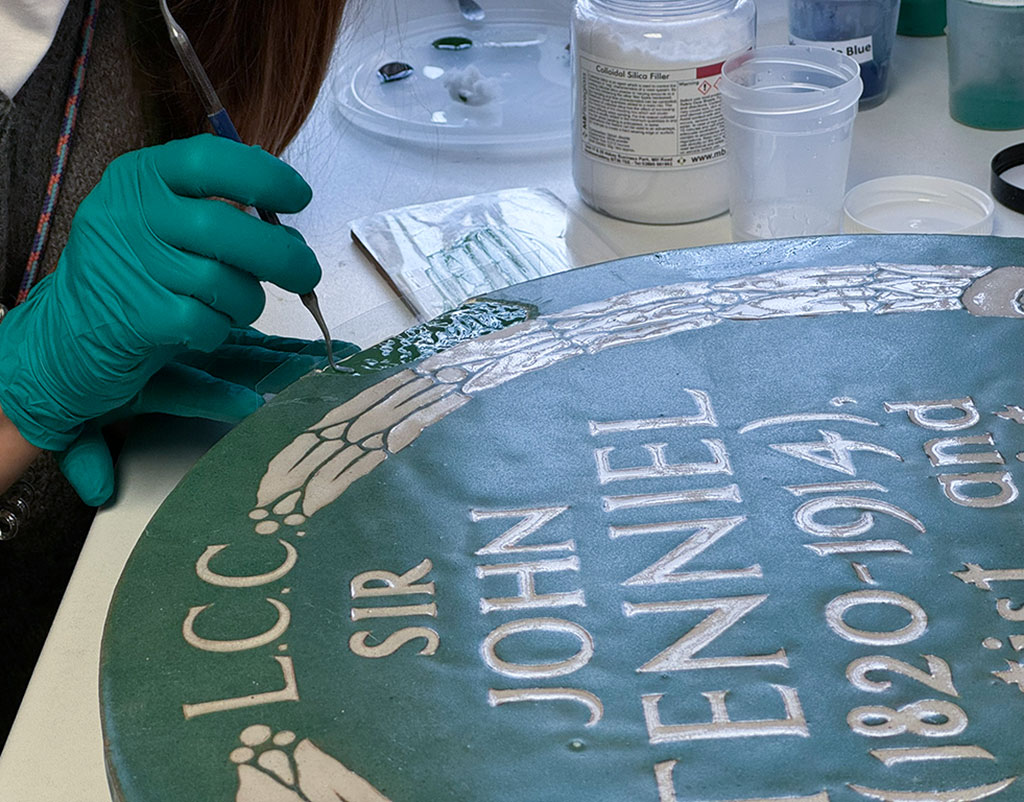
English Heritage plaques are made from a white stoneware body. After firing and glazing they are extremely hard, nonporous and frost-proof and the glaze does not fade or change colour. The surface of each modern plaque is slightly domed to encourage self-cleaning by rainwater, and the lettering, because it is handpiped, is slightly raised.
Blue plaques are created by highly skilled artisan craftspeople. Ned Heywood and Julia Land of Ned Heywood Heritage Ceramics, based in Chepstow, began making ceramic plaques for us in 2018. Before this, Frank and Sue Ashworth made plaques for around 40 years.
As long as plaques are protected during any building works, they will last for as long as the building to which they are attached. Some plaques from the scheme’s history have lasted over 150 years and counting.
Installing Plaques
Each building proposed for a plaqueis carefully assessed for suitability, and to ensure that any plaque is designed and positioned sensitively. We consider how a plaque will fit with the architecture of the building and ensure it is best located to catch the eyes of passers-by.
Blue plaques are erected on buildings via one of two methods. Most plaques are just under 500mm in diameter and are inset by up to 50mm to rest flush with the surface of the building. This fits well with the brickwork of most buildings up to the middle of the 20th century and means they can safely accommodate an inset plaque. For newer buildings made with cavity walls or concrete, surface-mounted plaques are used.
Experienced plaque installer Trevor Ramsay has been putting up plaques since the late 1980s.
Looking After Blue Plaques
The care of each plaque rests with the property owner. English Heritage is always happy to offer advice on cleaning or conservation where this would be helpful, though this is rarely necessary.
Because of the way they are made, blue plaques on buildings are extremely durable. Sometimes, plaques have outlasted the building on which they were placed.
More About Blue Plaques
-

The Changing Face of Blue Plaques
Explore how the design – and colour – of London’s blue plaques has changed over the years.
-

About Blue Plaques
Find key information about the London blue plaque scheme.
-
Propose a Plaque
Discover how to put forward a proposal for a person or group who you think deserves a London blue plaque.