
A History of the Royal Observer Corps
The Royal Observer Corps (ROC) was formed initially to operate as the ‘eyes and ears’ of the Royal Air Force. Established in 1925, it began as a uniformed civilian organisation for detecting, identifying, tracking and reporting hostile aircraft.
In 1955, when fear of nuclear attack dominated international politics, the ROC’s operations expanded to include detecting and reporting nuclear explosions and monitoring radiation fallout, from a nationwide network of bunkers. Thousands of volunteers operated this network throughout the Cold War period. They gave up their spare time to prepare, as best they could, for a nuclear attack, and to provide fallout warnings to the public.
Building the observer network
Although the Observer Corps was officially formed in 1925, its roots lie in a system of observation posts built to boost Britain’s defences during the First World War. The use of Zeppelin airships to drop bombs onto the United Kingdom in late 1915 demonstrated the need for a British system monitoring hostile aircraft for both defence and warning purposes.
The patchwork system of ‘spotting stations’ introduced at this stage consisted of posts located in railway stations, army camps, police stations and lighthouses. Those operating them – including Special Constabulary, railway staff, light ship crews, boy scouts and the military – relied on the existing telephone networks to report aircraft spotted within 60 miles of London.
In 1916 these spotting stations were replaced by around 200 observation posts. These were predominantly in London, the anticipated prime target for enemy bombing.
From May 1917 Germany began to attack London with more strategic fixed-wing bombers. To manage the new threat, the War Office set up the London Air Defence Area. When fully operational this comprised coastal and inland observation posts, balloon aprons and aerodromes, searchlight and gun stations, and emergency landing grounds. This network of posts, connected to 25 sub-controls, laid the groundwork for the subsequent formation of the ROC in 1925.
The Second World War
The monitoring network was expanded in the early 1930s in response to the growth of German air power. Arms factories as well as transport infrastructure were anticipated bombing targets. Observation was now needed beyond London.
In August 1939 all members of the Observer Corps were mobilised, and control was transferred from the police force to the Air Ministry. Observers manned observation posts continuously from the declaration of war to VE day in May 1945.
These observers monitored and plotted the location of aircraft visible from Kent during the Battle of Dunkirk in May–June 1940, which resulted in the evacuation of British troops in Operation Dynamo. However, it was their role in the Battle of Britain that resulted in royal recognition. As the Royal Air Force (RAF) engaged with the German Luftwaffe in the skies, observers on the ground identified and tracked hostile aircraft 24 hours a day.
On 9 April 1941 King George VI awarded recognition to the Corps – henceforth the Royal Observer Corps. It was also in 1941 that women were first recruited to the Corps. Civilians, both women and men, came to be employed as either Class A observers, who worked 56 hours per week, or Class B members, who worked up to 24.
The information the Corps provided on the location and bearing of German bombers enabled the issue of air-raid warnings during the Blitz, which continued into summer 1941. Later they helped spot incoming V1 and V2 rockets: on 13 June 1944, observers at the ROC Post located on top of Dymchurch Martello Tower on the Kent coast reported the first V1 flying bomb to enter the UK.
The nuclear threat
The ROC continued to monitor the skies after the war ended. At that time the observer network consisted of 1,560 posts across Wales, Scotland and England.
It was clear by the late 1940s, however, that fast-paced developments in nuclear weapons and radar technology had rendered the wartime observation model insufficient. Nuclear weapons presented new, and deadly, heat, blast and fallout considerations.
To meet the new atomic threat, the Commander-in-Chief of the RAF’s Fighter Command, Air-Marshal Sir Basil Embry, developed the ‘Rotor Plan’, under which RAF operation sector areas were reorganised and ROC sectors were reconfigured to align more closely with them. It reduced the number of section ‘groups’ from 40 to 31, and expanded them into Northern Ireland. RAF operations centres were moved into new underground bunkers. This new structure, with its accompanying early warning equipment, was to be fully operational by November 1953.
Cold War Operations: a new role
From 1955, amid the ever-growing tensions of the Cold War, the ROC’s now reduced part in tracking aircraft was supplemented by a new role – detecting and reporting nuclear explosions and monitoring the resulting radioactive fallout.
In 1957 the British government set up the United Kingdom Warning and Monitoring Organisation (UKWMO), under the direct control of the Home Office, to provide civil and military authorities with essential information during a nuclear attack. The ROC operated as part of it.
The role of the ROC’s monitoring posts, such as the one located in the grounds of Scarborough Castle, was to collect nuclear fallout and blast data using their monitoring equipment – ground zero indicator, fixed survey meter, and bomb power indicator – and communicate this to group control bunkers, where it would be triangulated and plotted. This information could be used by the UKWMO and meteorologists to forecast the range and movement of radioactive fallout. Observers hoped that their work would protect and support members of the population after a nuclear attack – whether those surviving a direct attack, or those affected indirectly by fallout.
By 1962, the ROC network had been reorganised to consist of about 1,500 underground posts (subterranean concrete boxes) and 31 group ‘controls’ (previously ROC ‘centres’). The number of controls was reduced to 25 in 1968, when the number of posts was also reduced, to about 800.
Controls were designed to be ‘nuclear protected buildings’ – able to withstand the effects of a nuclear blast at a distance and subsequent fallout, but not a direct hit. While some group controls were converted from Second World War anti-aircraft operations rooms, many were purpose-built as either semi-sunken or above-ground blockhouse buildings. These structures housed operational accommodation for up to 60 staff, a kitchen and canteen, decontamination facilities, a communications (or ‘tape’) centre, and a split-level operations room with a balcony.
20 Group Control York
The York Cold War Bunker, known as No. 20 Group Control York, built in 1961, was one such bunker. It acted as a coordinating facility for data collected by over 40 posts across the Yorkshire region, while also itself acting as a post. Radiation data would have been simultaneously received from associated posts and read on equipment within the bunker.
The Corps’ observers, stationed either at monitoring outposts or Group Controls like 20 Group York, would train weekly with monitoring equipment, and undertake nationwide monthly exercises that simulated nuclear war. During such exercises, crews of 30 observers on three rotating shifts would respond to simulated radiation data provided by the UKWMO. Otherwise, the ROC ran the group headquarters with a permanent staff of three, while the monitoring posts were unmanned. It was only during training exercises, or if war was threatened, that the whole system would be manned.
Indeed, across the 30-year operational period, including during the Cuban Missile Crisis of 1962, the ROC was never called upon to fully man its nuclear monitoring system.
The volunteers
It was the people who made the Corps, the friendship, and the training, and the expertise, although thankfully we were never called into action.
Jenny Morris, ROC volunteer 1970–93
The ROC served a social as well as apocalyptic function. The training given to observers brought the volunteers together and made the crews very tight knit. Observers say the camaraderie they experienced during training was a core element of their time in the ROC. Evening training and weekend exercises were key social events.
Volunteering with the ROC brought people together from all walks of life. Some observers had military or engineering backgrounds, but many learned the skills needed to plot radiation for the first time in the Corps. Observers who had joined the ROC when it served an aircraft-spotting role in the Second World War worked alongside teenagers who joined the Corps as soon as they were able.
ROC training and ‘master tests’ ensured that all observers had the knowledge necessary to operate the bunker’s equipment. Women often worked as ‘post display plotters’, receiving information from those working at posts to pass on to observers at Controls to be triangulated and plotted. Observers had to work efficiently as a team to allow UKWMO scientists to make accurate radiation forecasts.
That was one of the great things about the Observer Corps – that it brought people from really different circumstances, whether that’s age, gender, occupation, education and threw them together, in a way that they all accepted, everyone had a contribution to make. It was a real strength of the Royal Observer Corps that it did that, and did it so successfully.
Tim Kitching, ROC volunteer 1976–89
Out of the cold
The combination of Ministry of Defence cost-cutting and the changing perception of nuclear warning requirements resulted in the stand down of the ROC’s monitoring posts and group controls in 1991.
However, the Ministry decided to retain the Nuclear Reporting Cell component of the Corps. This Cell continued to supply the three branches of the armed forces with nuclear, biological and chemical assessments until December 1995. During this time, a small number of ROC volunteers were retained to predict and report the yield of nuclear weapons and the estimated nature of their fallout, as well as to forecast areas of chemical hazard and associated meteorological considerations. Their name was changed to Nuclear, Biological, and Chemical Cells to reflect this expanded role.
Now restored and open to the public, the York Cold War Bunker is an eerie reminder of the chilling period of history when ROC volunteers worked in it to simulate nuclear attack.
By Megan Thomas
Top images: left: members of No. 20 Group relaxing in the canteen at York’s Cold War Bunker (© private collection); right: the Royal Observer Corps’ insignia, bearing its motto ‘Forewarned is forearmed’
Quotations courtesy of Bentley Priory Museum
Further reading
Royal Observer Corps: The ‘Eyes and Ears’ of the RAF in WWII – An Official History (Yorkshire, 2022)
Bennett, Luke (ed), In the Ruins of the Cold War Bunker: Affect, Materiality and Meaning Making (London, 2017)
Find out more
-
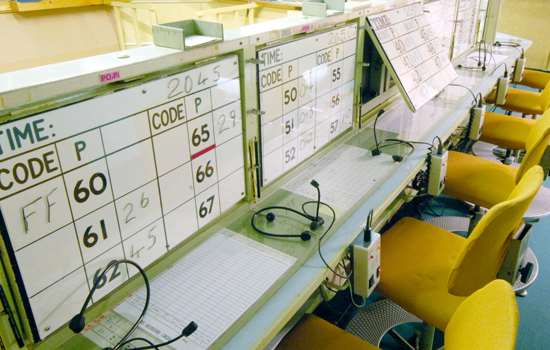
Visit the bunker
Go underground to visit the York Cold War Bunker as it would have looked when in operation. Pre-booking is essential.
-

History of York Cold War Bunker
Learn more about the history of York's Cold War Bunker and the crucial role it played in Britain’s defence against the impact of nuclear strikes.
-

The Cold War
After the Iron Curtain divided the world, Britain became an atomic power and fought in proxy wars. Learn about the threats and tensions of the Cold War era.
-
Vigilant State: York Cold War Bunker and the Royal Observer Corps
In this episode of our Speaking with Shadows podcast, Josie Long visits the bunker and hears from an ROC volunteer who trained there.
-
EH Podcast: Computers, protection and peace in the Cold War era
Hear how the Cold War affected daily life for ordinary people and how anxiety about the possibility of conflict was normalised.
-

Commemorating 100 years
Find out how the ROC itself is marking 100 years since the formation of the Corps and exploring the stories of its volunteers.