
Emma Gaggiotti at Osborne
Italian artist Emma Gaggiotti was one of the few female artists of the 19th century to attain international recognition during her lifetime. She was a pupil of the artist Nicola Consoni and later Tomasso Minardi – both followers of the Italian Purist movement, which aimed to revive the aesthetic purity of the early Renaissance painters.
In the 1850s and 1860s Prince Albert and Queen Victoria acquired six paintings by Gaggiotti, which are now together for the first time at Osborne. The paintings open a window onto Victoria and Albert’s personal tastes and progressive support for female artists.
Female Artists in Victorian Britain
When artists like Edwin Landseer and Franz Winterhalter were painting royals, dogs, stags and landscapes – examples of which are all around us at Osborne – what were female artists doing? In Victorian Britain it was acceptable for working class women to paint tiles and ceramics for a living, but it was not expected that they had taste or refinement. A middle-class or upper-class woman was expected to possess artistic skill and an interest in culture, but certainly not to pursue painting as a profession.
Female art rarely features in public collections. It was not bought by major male collectors and was therefore rarely bequeathed to the nation or to prominent institutions. Where they were, they were often overlooked. For this reason, it is interesting that the collection of Prince Albert and Queen Victoria at Osborne contains art and sculpture created by 20 women, including their daughters Louise and Vicky and professional artists including Susan Cavendish, Norah Grant and Henrietta Ward. The latter three women are almost unheard of; a fourth is Emma Gaggiotti Richards.
Emma Gaggiotti
Gaggiotti was born in Rome in 1825. Her father, Camillo Gaggiotti, was Minister of War and both he and her mother, Angelina, were part of the artistic circle of Rome at a time when the city was becoming increasingly cosmopolitan.
Gaggiotti began her training with Nicola Consoni (1814–84) and later Tommaso Minardi (1787–1871). Both mentors were influenced by the Renaissance artist Raphael and were part of the Italian Purist movement. Purism focused on precise outlines, soft colour palettes and religious devotion, emphasising moral integrity and historical accuracy.
These ideas were clearly passed on to their pupil and can be seen in Gaggiotti’s paintings at Osborne.
Aged 23, Gaggiotti married British journalist Alfred Richards and the couple moved to London. In a matter of months, Gaggiotti and Richards separated, but for the rest of her life she was known as Mrs Richards. The following year, 1849, Gaggiotti wrote to sculptor John Gibson, creator of the life-size statue of Queen Victoria in the Grand Corridor at Osborne, asking him to use his influence on her behalf at the English Court. At the time, she was supporting both herself and her mother by painting professionally. Gibson possibly assisted her introduction to Prince Albert.
By the end of the 1850s, Gaggiotti had moved to Berlin, where she was painting for the Prussian royal family. Defying all odds for women at the time, she had established a reputable career in painting within her own lifetime. Following the death of Kaiser Wilhelm I in 1888, Gaggiotti returned to Italy, ultimately settling in Velletri, where she died in 1912.
Prince Albert – Art Patron
Prince Albert’s taste in art was serious and academic. He had a deep interest in the work of Raphael, and of the Renaissance in general. In this, Prince Albert was supported by German art historian Ludwig Grüner after the two met in Rome in 1838 during Prince Albert’s Grand Tour. Grüner would go on to became art advisor to the royal couple and would act as agent for Queen Victoria in the purchase of over 60 paintings.
At some point before his move to England in 1843, Gaggiotti painted Grüner’s portrait. We can assume that Grüner had been the conduit through which Gaggiotti and Prince Albert met, perhaps assisted by the sculptor John Gibson, and her art tutor Consoni – both already known to the royal couple.
Through whichever means Gaggiotti came to the attention of Prince Albert, in 1850 he commissioned four works by Gaggiotti, which he presented to Queen Victoria over that and the coming two Christmases. The paintings represented Faith, Hope, Charity and Religion, and the influence of the work of Raphael can be seen in all four.
In 1861 Prince Albert gifted another Gaggiotti piece – Aurora – to Queen Victoria for her birthday. Aurora, the Roman goddess of the dawn, is pictured by Gaggiotti according to traditional iconography – as a young girl, dressed in the colours of the dawn and accompanied by three putti.
Explore the paintings

Hope


Faith


Religion


Charity


Aurora

Self-Portrait
After the successful 1850 commission by Prince Albert, Queen Victoria went on to commission Gaggiotti herself. She asked the artist to create a self-portrait after seeing one of Gaggiotti’s portraits at the Royal Academy of Arts annual exhibition. Victoria presented the finished work to Prince Albert at Christmas in 1853.
In her self-portrait Gaggiotti – as a female artist and therefore on the periphery of artistic acceptability – firmly situates herself within the masculine tradition of self-portraiture. Her twisted three-quarter-length pose is reminiscent of the Old Master self-portraitists such as Rembrandt, Vermeer and Van Dyck. Her clothing is modest and her pose unassertive, and yet there is something determined and challenging in her expression.
Today the name Gaggiotti is almost unknown to us – not because she was not a good artist, but because she was female. For a woman to be a professional artist in Victorian Britain was to challenge the very nature and status of art and gender. The acquisition of Gaggiotti’s work by Victoria and Albert therefore says a lot not only about Gaggiotti’s unique success as a professional female artist in the 19th century, but also about Victoria and Albert’s progressive approach of encouraging the patronage of female artists.
The Gaggiotti pictures at Osborne were commissioned as personal gifts, intended to be enjoyed in domestic spaces. The choice of subject, style and artist therefore reveal the shared private preference of the royal couple – Albert in particular – in a way that a commission of great art for public consumption could not.
Read more
-
Women in History
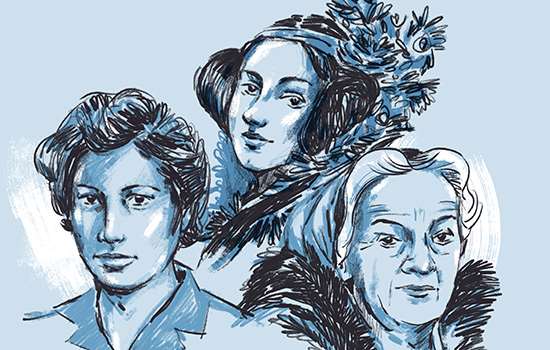
Read about the remarkable lives of some of the women who have left their mark on society and shaped our way of life – from Anglo-Saxon times to the 20th century.
-

Osborne Collection Highlights
The collections at Osborne remain the single most important example of the shared tastes of Queen Victoria and Prince Albert. View some of the collection highlights.
-

Birthdays at Osborne
Our knowledge of Victoria and Albert’s birthday celebrations and traditions provides a revealing insight into family life at Osborne, their seaside home.