EWART, William (1798–1869)
Plaque erected in 1963 by London County Council at 16 Eaton Place, Belgravia, London, SW1X 8LT, City of Westminster
All images © English Heritage
Profession
Reformer, Politician
Category
Philanthropy and Reform, Politics and Administration
Inscription
WILLIAM EWART 1798–1869 REFORMER lived here
Material
Ceramic
Notes
The plaque was originally erected in 1952 at 6 Cambridge Square. When that building was demolished it was re-erected in its present location in 1963.
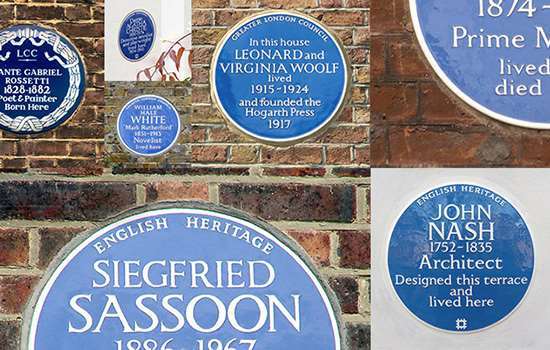
William Ewart was known for his reforming campaigns in Parliament and for proposing a scheme of commemorative plaques, which grew into the blue plaques scheme that continues today. Ewart is commemorated by a blue plaque at 16 Eaton Place, Belgravia, his former home.
William Ewart was born in Liverpool on 1 May 1798. He studied at Eton College and Christ Church, Oxford, then trained as a barrister before being elected to Parliament for Bletchingley in Surrey in 1828. Ewart married his cousin, Mary Lee, and they moved to 16 Eaton Place in 1830 as newlyweds. The Ewarts were the first occupants of the house, which was the work – like its neighbours – of the master builder Thomas Cubitt.
In September that year, Ewart’s friend and the MP for Liverpool, William Huskisson, died. Ewart, who had just lost his Bletchingley seat in the general election, was elected in his place after a close contest. Ewart was a liberal with radical leanings. Although his family fortune came partly from West Indian estates worked by enslaved people, he was in favour of the abolition of colonial slavery, which he indirectly attacked via motions on sugar duties.
Ewart successfully campaigned to end capital punishment for the theft of animals or for sacrilege, and sought the total abolition of the death penalty, later serving on a royal commission on the subject. Other humanitarian campaigns included his bill to abolish hanging in chains, passed in 1834, and an 1836 act to allow felons to be defended by legal counsel.
Campaigns for culture
From 1836, Ewart began promoting education and public libraries, which became a significant focus for the rest of his life. His select committee’s report on arts and manufactures led to the foundation of the School of Design at Somerset House, London. In 1845 he supported the Museums Act that enabled town councils to raise funds for local museums, and he led work to create nationwide access to public libraries via the Libraries Act of 1850.
He also proposed the idea of a commemorative plaque scheme for London in 1863, which was adopted by the Society of Arts a few years later.
Mr W. Ewart … rose to ask … whether … it may be practicable to have inscribed on those houses in London which have been in habited by celebrated persons, the names of such persons.
Hansard, 17 July 1863
Ewart was commemorated himself by a plaque in 1952 at 6 Cambridge Square, Paddington, but this house was later demolished. The plaque – which is smaller than most – was re-erected at 16 Eaton Place almost exactly a century after his original proposal for a plaque scheme, in 1963.
When Mary Ewart died in 1837 after having five children in six years, William Ewart moved to Hampton, where he is also commemorated by a plaque.
Further reading
- SM Farrell, ‘Ewart, William (1798–1869)’, Oxford Dictionary of National Biography (2014) (access with a UK public library card)
Nearby Blue Plaques
See these places on an interactive Google map.